
EPR Forum highlights industry and government push for scalable, inclusive circular economy solutions

Updated: May 1
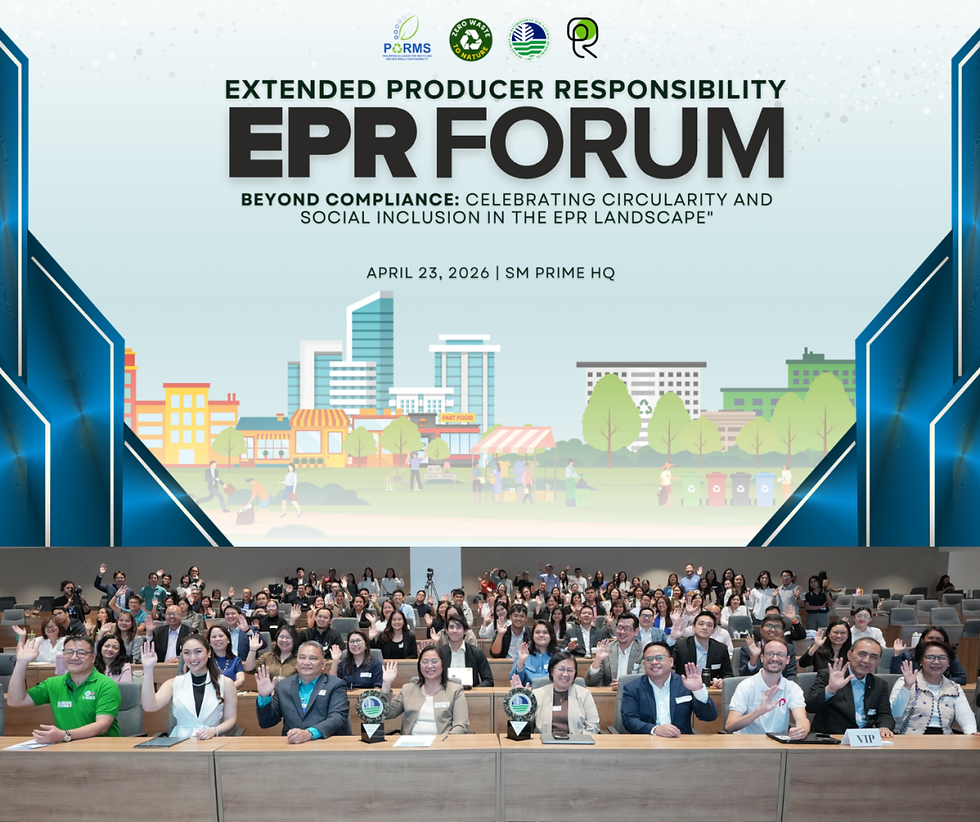
Pasay City, Philippines — April 23, 2026 — Government officials, major corporations, recyclers, and development partners gathered at the 2026 Philippine EPR Forum to highlight progress and address gaps in the country’s implementation of the Extended Producer Responsibility (EPR) Law.
Organized by the Philippine Alliance for Recycling and Materials Sustainability (PARMS) in collaboration with the Department of Environment and Natural Resources (DENR), the Forum brought together key stakeholders to discuss how to scale recovery systems, strengthen value chains, and improve coordination across sectors.
The event, held at the SM Prime Headquarters, carried the theme “Beyond Compliance: Celebrating Circularity and Social Inclusion in the EPR Landscape.”
EPR shifting from compliance to system implementation

PARMS President Engr. Jesus G. Reyes said the country is entering a new phase of EPR implementation, where the focus is no longer on adoption but on improving systems.
“We are no longer at the starting point. The question is no longer whether EPR works—but how we make it work better, at scale,” Reyes said.
He added that industry players remain committed to strengthening EPR systems through investments in recovery infrastructure, data systems, and partnerships.
“The private sector remains committed—not just to compliance, but to improvement. Because EPR only works when everyone shows up.”
DENR: EPR requires shared responsibility across sectors

In a recorded keynote message, DENR Undersecretary Jonas Leones described EPR as a fundamental shift in how the country manages plastic waste. ne of the most impactful discussions centered on social inclusion.
“EPR represents a shift in mindset. It is no longer simply a regulatory requirement; it is now a shared responsibility among producers, government, and communities,” Leones said.
He noted that companies are increasingly investing in recovery systems and recycling value chains, but emphasized that further work is needed to scale implementation and improve coordination.
“Moving forward, we must sustain our gains while addressing system gaps. This means scaling effective models, strengthening upstream interventions, and improving recovery systems.”
Leones also highlighted the need to integrate informal waste workers into formal systems.
“A sustainable system must also be an inclusive system,” he said.
Panel discussions highlight operational gaps and solutions
The Forum’s panel discussions focused on key challenges in implementing EPR at scale, particularly at the local level.

During the session on “Bridging Grassroots Diversion and National EPR Compliance,” waste diverters and community-based practitioners emphasized that national recovery targets depend on strengthening local systems.
Panelists cited the need for:
Improved coordination between LGUs and private sector partners
Investments in collection and sorting infrastructure
Standardized data and traceability systems
They also stressed the importance of integrating the informal waste sector into EPR systems to ensure both efficiency and social inclusion.

Consumer demand seen as critical to closing the loop
Another panel on behavioral change underscored the role of consumer demand in sustaining circular economy systems.The Forum featured presentations from leading companies demonstrating how businesses are translating EPR into operational systems from upstream design and reduction strategies to investments in recycling infrastructure and traceability systems.

Discussions focused on:
Addressing stigma around recycled products
Building trust through transparency
Strengthening communication and education campaigns

Industry showcases scalable EPR solutions

The Forum also featured presentations by major companies and rapid-fire pitches from waste diverters and recyclers, highlighting existing solutions that support EPR compliance.

These included:
Investments in recycling infrastructure
Traceability and data management systems
Community-based recovery programs
Participants said these initiatives demonstrate that the technical and operational solutions needed for EPR implementation are already available and can be scaled further.

Call for sustained collaboration
The Forum concluded with a call for continued collaboration among stakeholders to strengthen EPR systems and ensure long-term impact.
Reyes emphasized that progress depends on coordinated action:
“This is how policy becomes progress—when government, industry, and communities work together to build systems that last.”
Concept Note and Program File
Comments